Two members of the captis.space team at TU Dresden’s Institute of Aerospace Engineering (ILR) presented our latest results at the 76th International Astronautical Congress (IAC 2025) in Sydney, Australia (29 Sept–3 Oct 2025). Dipl.-Ing. Valentin Petzold and Dipl.-Ing. Georg Langer delivered a conference presentation on our paper, “Innovative configuration of external control surfaces for attitude and orbit keeping of nanosatellites in very low earth orbit.” The contribution summarizes all results to date and aligns directly with our V-LOG (Very Low Orbital Glider) development.
What the paper shows
Our work investigates an independent external control-flap system that generates aerodynamic control torques in Very Low Earth Orbit (VLEO) while keeping overall drag as low as possible and preserving internal volume for payloads and avionics. Unlike concepts that repurpose solar arrays, our flaps are dedicated control surfaces, allowing more freedom in material selection and minimizing trade-offs with power generation. The approach is designed to operate together with a commercial electric thruster, countering VLEO disturbances in both attitude and orbit.
The team reports promising attitude-control accuracy from a combination of:
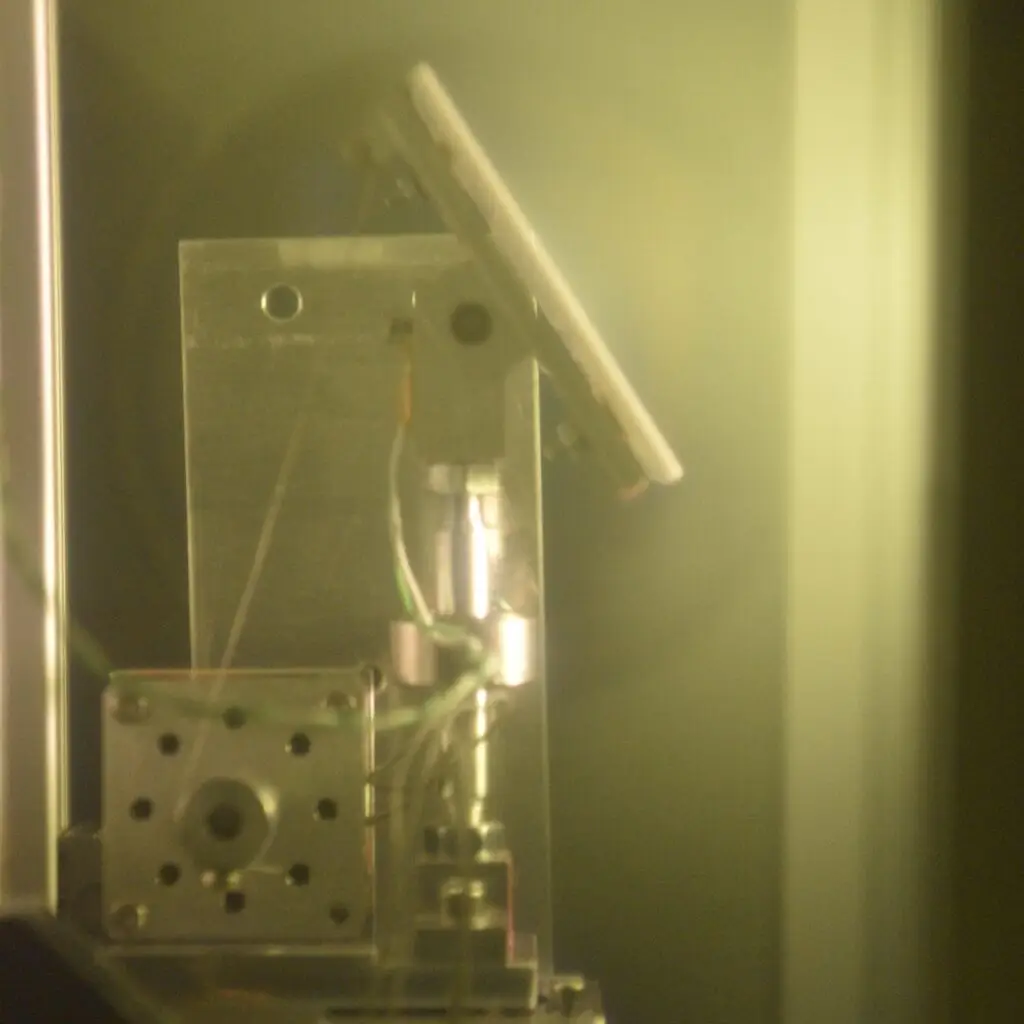
- Ground-based experiments on gas-surface (particle-surface) interactions under rarefied, VLEO-like flow conditions, and
- High-fidelity simulations that incorporate established atmospheric models (HWM14, JB2008, NRLMSISE-00) and interaction parameters derived from our lab work.
Building on TU Dresden heritage from the SOMP2b nanosatellite, the new platform targets operation around ~250 km altitude and provides a quasi-aerostable configuration with active damping: the spacecraft passively seeks an equilibrium attitude, while the flap system trims oscillation amplitudes and frequencies as needed.
Why it matters in VLEO
Below ~300 km, satellites face strong aerodynamic disturbances, especially about the yaw axis. Our findings indicate that an active flap system in this axis can avoid reaction-wheel desaturation, deliver higher peak control torques than conventional actuators in this regime, and require minimal internal volume, freeing capacity for instruments. We also address the known trade-offs: increased overall drag and the need for robust, low-risk stowage mechanisms for launch. Ongoing work focuses on material screening and refining gas-surface interaction (GSI) models to reduce torque-prediction uncertainties, thereby allowing less conservative control laws and better performance.
What’s next
These results feed directly into V-LOG under the captis.space program: informing flap geometry, materials, and predictive maneuver planning for our differential-drag-centric ADCS as we progress toward Critical Design Review (CDR). As we scale up testing and integration, we remain open to industry and research partnerships for materials, mechanisms, and VLEO operations.
Who was involved
Authors: V. Petzold, G. Langer, M. Trenkner, U. Brinker, M. Tajmar, T. Schmiel.
Presenters: Dipl.-Ing. Valentin Petzold and Dipl.-Ing. Georg Langer (ILR, TU Dresden).
Paper reference: IAC-25,D1,2,3,x100543. Slides/preprint: available on request.
Acknowledgement
This publication is based on scientific projects which were funded by the German Federal Ministry for Economic Affairs and Climate Action based on a resolution of the German Bundestag: “Very Low Orbital Glider – Eine sehr niedrig fliegende Kleinstsatellitenplattform mit innovativer Orbit- und Lagekontrolle” under the funding code 50RU2505. This publication reflects the views only of the authors, and the funding agencies cannot be held responsible for any use which might be made of the information contained therein.